
One Label or Many? How to Correctly Label Products with Removable Components
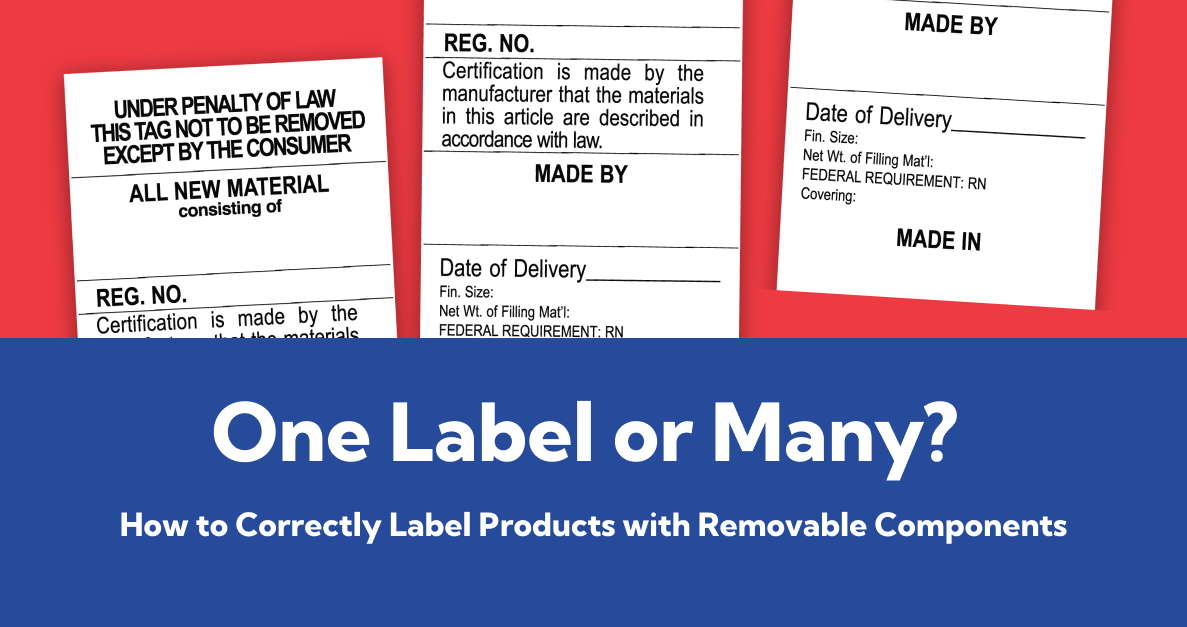
If you manufacture or sell upholstered products with removable components — think sofas with detachable cushions, car seats with inserts, or play yards with pads — chances are you've wondered: Do all these parts need their own law label?
The answer isn't one-size-fits-all and getting it wrong can expose your business to some serious compliance risk.
Below, we’ll break down exactly how to approach law labeling for products with removable or detachable components, with real-world examples to make the rules as clear as possible.
What Goes Into Law Labeling for Multi-Component Products
Law labels are a legal requirement in the United States for filled products like mattresses, pillows, upholstered furniture, and stuffed toys, governed by individual state regulations. Every label must disclose the filling materials used. And when a product has multiple distinct filled sections, the stakes get a little higher.
The challenge with removable components is that regulators want consumers to have accurate material information for every part of what they're buying. If a customer removes a cushion and loses the main label, do they still know what's inside? That's really the core question driving these rules.
The Key Question: Does Your Product Have a Main Filled Body?
Here's the most important thing to figure out before anything else: does your product have a main filled body — sometimes called the "shell" or "frame" — that's distinct from its removable components?
Here's the general rule of thumb:
- If your product has a main filled body, removable components like cushions or inserts can be disclosed on a single label using sectional disclosures.
- If your product has no main filled body and consists entirely of fully detachable parts, each component needs its own law label.
This distinction is really the backbone of compliant labeling for multi-component products, and it applies across furniture, juvenile products, and more.
Combined Labels: When One Label Can Cover Multiple Components
Let's walk through the most common example in the industry: sofas.
A standard sofa typically has a main filled body (the frame and base structure), plus removable back cushions and seat cushions. In this case, all components can be disclosed on a single law label using a sectional format. You'll need to list the number of cushions for each section alongside the material breakdown.
Here's what that looks like in practice:
BODY: POLYURETHANE FOAM PAD — 100%
BACK CUSHION: (2) POLYURETHANE FOAM PAD — 60% POLYESTER FIBER BATTING — 40%
SEAT CUSHION: (2) POLYURETHANE FOAM PAD — 70% POLYESTER FIBER BATTING — 30%
If throw pillows are sold as part of the sofa set, you can add those to the combined label with their own sectional disclosure.
Other products that commonly qualify for the combined label format include:
- Car seats (main seat body + removable inserts or head supports)
- Play yards and cribs (main frame + removable mattress pad or bassinet insert)
- Sectional sofas (frame + individual seat and back cushions)
The combined format simplifies your supply chain and keeps your compliance documentation in one place, which is a meaningful operational win.
Separate Labels: When Every Component Needs Its Own Label
Now let's look at the flip side. Consider an outdoor sofa or a modular seating set where there's no main filled body. Instead, the whole product is made up of individual seat cushions, back cushions, and maybe throw pillows — each fully detachable from one another, with no permanent filled frame holding it together.
In that scenario, the combined label format is not acceptable. Each component has to carry its own law label disclosing only the filling materials in that specific piece:
- The back cushion(s) get a label listing only back cushion materials.
- The seat cushion(s) get a label listing only seat cushion materials.
- Any throw pillows sold with the set each need their own label too.
This requirement exists because without a central body anchoring the product, there's no logical "home base" for a single compliance label. Each piece could be separated, resold, or used on its own, so each piece needs to stand alone from a regulatory standpoint.
And honestly, this is where a lot of manufacturers run into trouble. A combined label on a fully modular product feels like it should be fine but it isn't, and audits or retailer compliance reviews will catch it.
The Connecticut Exception
Even when your product qualifies for the combined label format, there's one more thing you'll want to factor in before moving forward.
The written laws of the State of Connecticut require that each removable component be labeled separately, regardless of whether a main body is present. Connecticut is currently the only state with this specific written requirement, but it's a significant one if your products are sold there.
That means your company needs to do a risk assessment before leaning on the combined label format for products with detachable components. Some things worth thinking through:
- How much of your product volume ships into Connecticut?
- Where do your retail partners distribute?
- How feasible is it to produce component-specific labels?
- What's your exposure if a state inspection or consumer complaint surfaces?
For many manufacturers, the safest move is to label each component separately from the start, especially if you're distributing nationally and can't easily control where your product ends up on the shelf.
Match Your Label Format to Your Product Structure
When it comes to law labeling for products with removable components, it really does come down to one foundational question: Does your product have a main filled body?
If yes → a combined sectional label is generally your best path forward (just keep that Connecticut exception in mind).
If no → you'll need separate labels for each detachable component.
Getting this right protects your brand, keeps you on the right side of state regulations, and keeps your retail partners happy. When in doubt, don't guess; We’re happy to help!
Stay up-to-date with American Law Label
"*" indicates required fields


