
When 50/50 Isn’t Exactly 50/50: A Manufacturer’s Guide to Law Label Tolerances

If you manufacture pillows and comforters by the thousands, you already know that no two units come off the line with exactly the same fill blend. A run labeled 50% polyester fiber and 50% polyurethane foam might test at 47/53 on one day and 52/48 the next. The question our customers ask more than almost any other is: “How much of that variation does the law actually allow?”
The answer depends on which label you're looking at.Law labels come in more than one type, and the ones that disclose hidden filling materials are regulated state by state, while FTC textile labels cover fiber content under federal rules.
Why Tolerance Questions Cost Manufacturers Time And Money
A lab result that lands outside the allowed range is one of the most common reasons law labels fail retailer and third-party testing, and by the time a failure comes back, the product is often already packed and waiting to ship. Fixing it at that stage usually means relabeling inventory in the warehouse, which is why so many manufacturers end up correcting law labels with adhesive Tyvek labels rather than reprinting from scratch.
The stakes on the federal side are higher still. The FTC treats each mislabeled item as a separate violation, and a Textile World overview of textile labeling notes that the last companies the FTC publicly pursued for fiber mislabeling settled for penalties of $2.5 million and $3 million. Knowing your tolerances before production is far cheaper than learning them from a failed test or an enforcement letter.
Law Label Tolerances By State
Law label tolerances come from each state's own statutes and regulations, so the allowed variation changes depending on where your product is sold.
Here's what the written laws say in the states with law label requirements:
| State | Written tolerance | What to know |
| California | 10% of the smaller component | A product labeled 50% polyester fiber / 50% polyurethane must contain at least 45% polyester fiber |
| Connecticut | ±10% of each filling material | No tolerance for "all," "pure," or "100%" claims |
| Detroit | ±10% for each ingredient in feather or down blends | No tolerance for "pure" or "100%" claims |
| Ohio | ±10% by weight | Intended for unintentional processing errors, with no tolerance for "all," "pure," or "100%" claims |
| Oklahoma | ±10% by weight | Allowed for unintentional variations |
| Pennsylvania | 10% for felted mixtures and feather or down mixtures | No written tolerance for other filling materials |
| Utah | Federal fiber tolerance (3%) | Does not apply to plumage products |
| Delaware, Massachusetts, New York, North Carolina, Rhode Island, Virginia, Washington D.C. & West Virginia | None written | Label to your actual tested content |

A few patterns stand out. Most states that publish a tolerance set it at 10%, but California calculates that 10% against the smaller component of a blend, which makes it noticeably tighter than a flat ±10%. Utah stands apart by adopting the federal 3% standard, so a fill blend that passes comfortably in Ohio could fall outside the allowed range in Utah.The rule that catches manufacturers most often involves absolute terms. In Connecticut, Detroit, and Ohio, a label reading "all," "pure," or "100%" gets no tolerance at all, so a pillow labeled "100% polyester fiber" has to contain exactly that. If your production process introduces even a small amount of another material, list it on the label.For states without a written tolerance, the safest approach is to label your actual tested content and build your fill targets around the strictest standard in the states where you sell.
FTC Textile Label Tolerance: The 3% Rule
Fiber content on FTC textile labels follows one national standard. According to the FTC's guide, fiber content claims carry a 3% tolerance. If a label says 40% cotton, the actual cotton content can fall anywhere from 37% to 43% of the total fiber weight.
That tolerance exists to cover small, unintended inconsistencies in manufacturing, and it doesn't give you room to round in your favor. If you know a fabric contains 37% cotton, the label should say 37% cotton. A deviation beyond 3% counts as mislabeling unless you can show it came from unavoidable manufacturing variation despite due care.
There are two practical details worth keeping in mind:
- Rounding is allowed
Fiber percentages may be rounded to the nearest whole number, so 60.4% polyester and 39.6% cotton can be labeled 60% polyester, 40% cotton. - Single-fiber claims get no tolerance
A blouse that is 97% silk and 3% polyester can't be labeled "100% silk," because the polyester was added on purpose.
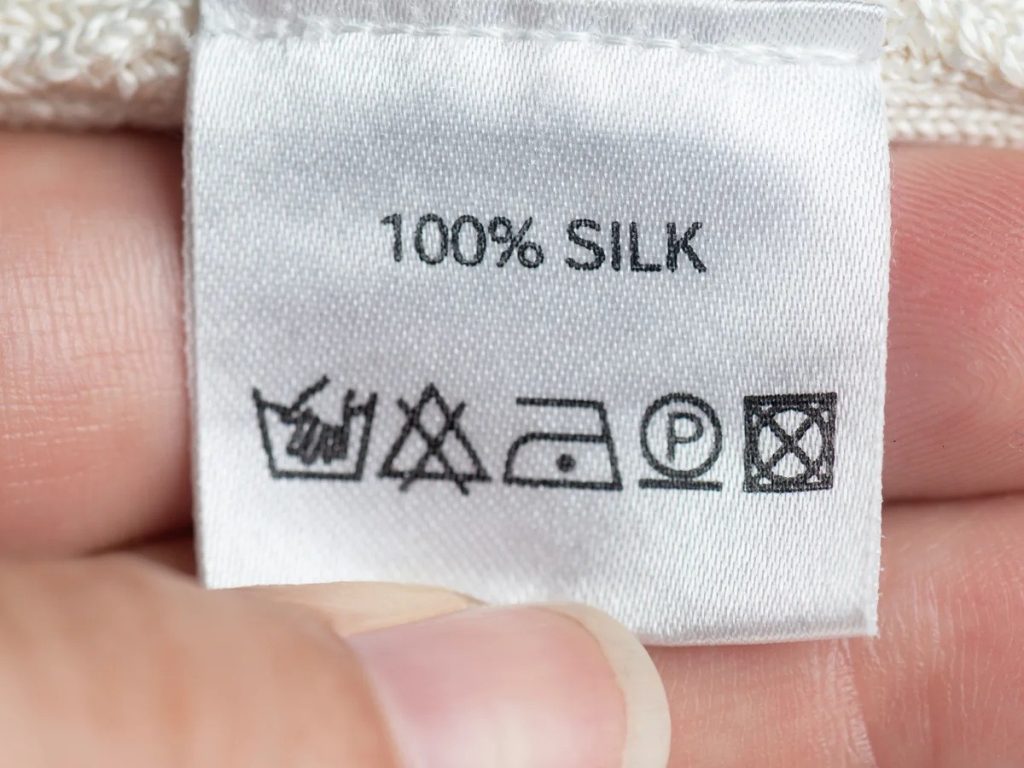
Wool products work a little differently. The Wool Act doesn't set a numeric tolerance, but the FTC applies the same 3% standard in practice, with no tolerance for labels that say a product is entirely wool or cashmere.
Down And Feather Product Classification Thresholds
Down and feather products come with an extra layer that isn't quite a tolerance in the traditional sense. Industry standards set classification thresholds, which determine how much down or feather a product must contain before it can carry a particular name, and the order of the words on the label matters.
| Label name | Down content | Feather content |
| Down & Feathers | 50% to 70% | 30% to 50% |
| Feathers & Down | 5% to 40% | 60% to 95% |
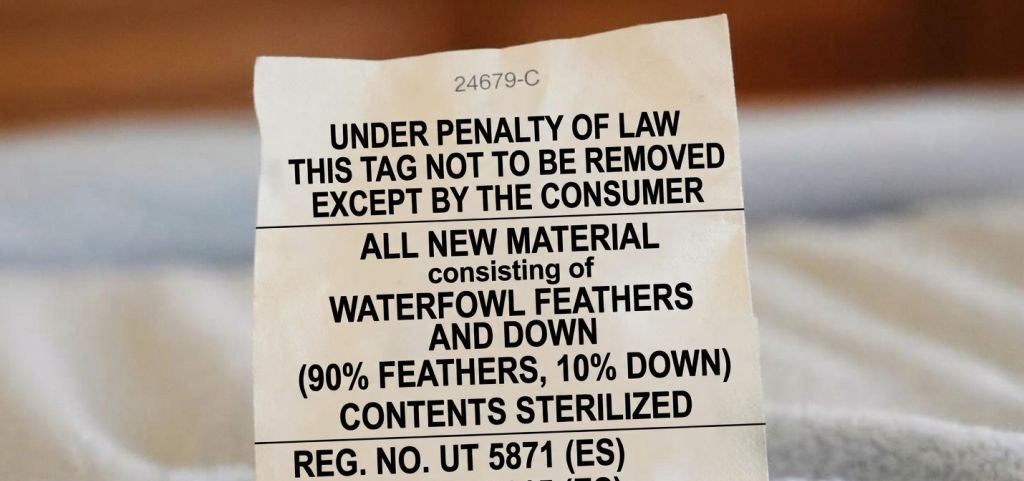
A pillow with 55% down and 45% feathers qualifies as "Down & Feathers," while one with 20% down and 80% feathers must be labeled "Feathers & Down." Swapping the order on a label is one of the easiest ways to end up with a product that doesn't match its description.
There is also a limit on how much down fiber, feather fiber, damaged feathers, landfowl feathers, and residue a product can contain before those components must be disclosed. This guidance comes from IABFLO and follows the USA-2000 labeling standards. For example, a product marketed as "DOWN & WATERFOWL FEATHERS" can contain a maximum of 10% down fiber or 10% feather fiber, and anything above that must appear as its own line item in the filling section of the law label.
The FTC adds its own expectations as well. Its guide to advertising and labeling feather and down products says a stated down percentage should deviate by no more than 5%, and that pillows which consistently test at 45% down should be relabeled to say so rather than claim 50%.
If down and feather products make up a meaningful part of your line, our Down & Feather Product Labeling: An American & Canadian Compliance Guide and Workbook puts these thresholds and the matching Canadian requirements in one reference your team can keep at hand. For a quick primer before you order, read our practical guide to labeling down and feather products in the U.S. and Canada.
Get Your Fill Percentages Right Before The Label Goes To Print
Tolerances give you breathing room for normal manufacturing variation, but they work best when your label starts from accurate, tested content.
A law label audit from American Law Label checks your filling descriptions against the requirements in every state where you sell, so problems surface before production instead of after a failed test. When it's time to print, our law label design and printing team builds labels that reflect your real fill blend, and every order starts with a label proof you can review before anything is printed.
If you'd like help setting fill targets your production line can actually hit, request a quote or call 1-888-LAW-LABEL to talk with our team.
Stay up-to-date with American Law Label
"*" indicates required fields


