

If you import, manufacture, or assemble products for the U.S. market, you’ve likely faced this question at some point:
“Some of it’s made overseas, but we do work on it here. Can we add that “Made in USA” label?”
It’s a reasonable question. It’s also one of the most common ways well-meaning companies stumble into compliance trouble.
The confusion usually comes from mixing two different regulatory frameworks. U.S. Customs and Border Protection focuses on country-of-origin marking for imported goods, while the Federal Trade Commission focuses on whether U.S.-origin claims are truthful and non-misleading to consumers.
Both matter and they overlap. But they’re not the same and your labels need to satisfy both.
What Customs Requires for Imported Products
From a Customs standpoint, the expectation is clear: every article of foreign origin entering the United States must be legibly marked with the English name of its country of origin, unless a specific legal exception applies. This means that a stuffed toy made in Germany can’t be marked “Deutschland” and a pillow made in Sweden can’t be marked “Sverige.” The marking must be sufficiently permanent and visible to inform the ultimate purchaser.
This requirement exists regardless of marketing goals. Customs is not evaluating whether a product feels “American” or whether it includes some U.S. labor later in the process. Its role is disclosure. If a product is considered foreign origin for Customs purposes, the country-of-origin marking must appear.
Where importers and manufacturers often get tripped up is assuming that domestic assembly, filling, or finishing automatically overrides this requirement. It doesn’t. If a product is imported or deemed foreign origin, that marking obligation still applies — even when meaningful work happens in the U.S. after importation.
What the FTC Means by “Made in USA”
Once you choose to make a U.S.-origin claim on a label, hangtag, website, or other marketing material, the FTC’s rules apply.
According to FTC guidance, an unqualified “Made in USA” claim is only appropriate when a product is “all or virtually all” made in the United States. This means that the significant parts, processing, and labor must be of U.S. origin, with only negligible foreign content.
Final assembly in the U.S. alone does not meet this standard and neither does packaging, labeling, or light processing. If a product includes imported materials or components that play a meaningful role in the finished item, an unqualified “Made in USA” claim is typically not allowed.
This standard exists because consumers reasonably interpret “Made in USA” to mean the product is essentially American-made from start to finish and the FTC evaluates claims based on how they are likely to be understood, not on intent.
When Qualified Claims Are the Right Answer
For many importers and manufacturers, the most accurate and defensible approach is a qualified Made in USA claim.
A qualified claim explains the extent, type, or location of U.S. involvement while clearly indicating that the product is not entirely of domestic origin. The FTC specifically allows these claims when they are truthful, substantiated, and limited to the actual process or components involved.
In practice, this often looks like language such as:
- Assembled in USA
- Filled and Finished in USA
- Made in USA of domestic and imported parts
- Made in USA of domestic and imported materials
These statements work because they are specific. They highlight legitimate U.S. work without implying that the entire product meets the “all or virtually all” standard.
The FTC is also explicit that claims about specific processes or parts must not be framed in a way that suggests broader U.S. origin than what actually exists.
This is where vague patriotic language or imagery can create risk. Even without words, symbols like flags or maps can imply an unqualified claim depending on context.
Why Accuracy Matters More Than Ever
Consumer interest in “Made in USA” remains strong, but research shows that understanding of what the claim legally means is often incomplete. A Michigan State University study on U.S. country-of-origin labeling found that many consumers assume “Made in USA” means entirely domestic production, even when products include imported components. The researchers noted that this gap between consumer perception and legal reality increases the likelihood of misleading claims in modern supply chains.
Because origin claims can influence buying behavior, the FTC has made clear that it actively enforces the Made in USA standard.
In 2022, the FTC ordered Lions Not Sheep Products to pay $211,335 in civil penalties after the company was found to have removed “Made in China” tags from apparel and replaced them with “Made in USA” labels. The case made it clear that physically altering labels to imply U.S. origin without meeting the standard is a direct violation of FTC rules.
These cases are not outliers. They reflect an active enforcement posture that importers and manufacturers should factor into label decisions.
A Law Label Detail That Often Gets Missed
When law labels are involved, there is an additional nuance that matters.
Regulating agencies expect the country-of-origin statement on a law label to align with the suffix of the URN (Unique Registration Number). The URN suffix corresponds to the state or country where the manufacturing facility is registered.
For example, a URN ending in “CN” is registered to a China-based facility. A country-of-origin statement such as “Made in USA” would be inappropriate on that label.
It’s also important to understand that state agencies reviewing law labels do not verify Made in USA claims. Their review focuses on required disclosures and formatting, not on whether a product qualifies as wholly or partially U.S.-made. That means a label can be approved and still present FTC risk if the origin language overstates U.S. content.
Alignment across Customs rules, FTC guidance, and law label registration details is essential, especially when labels are combined.
Before You Print: A Practical Way to Think About Origin Claims
Before approving artwork, it helps to pause and ask a few grounding questions. Are you making an unqualified or qualified claim? Does the wording accurately reflect what actually happens in the U.S.? Does the country-of-origin statement align with the URN suffix? And could you substantiate the claim if asked?
Answering those questions upfront can prevent costly reprints, enforcement exposure, and retailer pushback later.
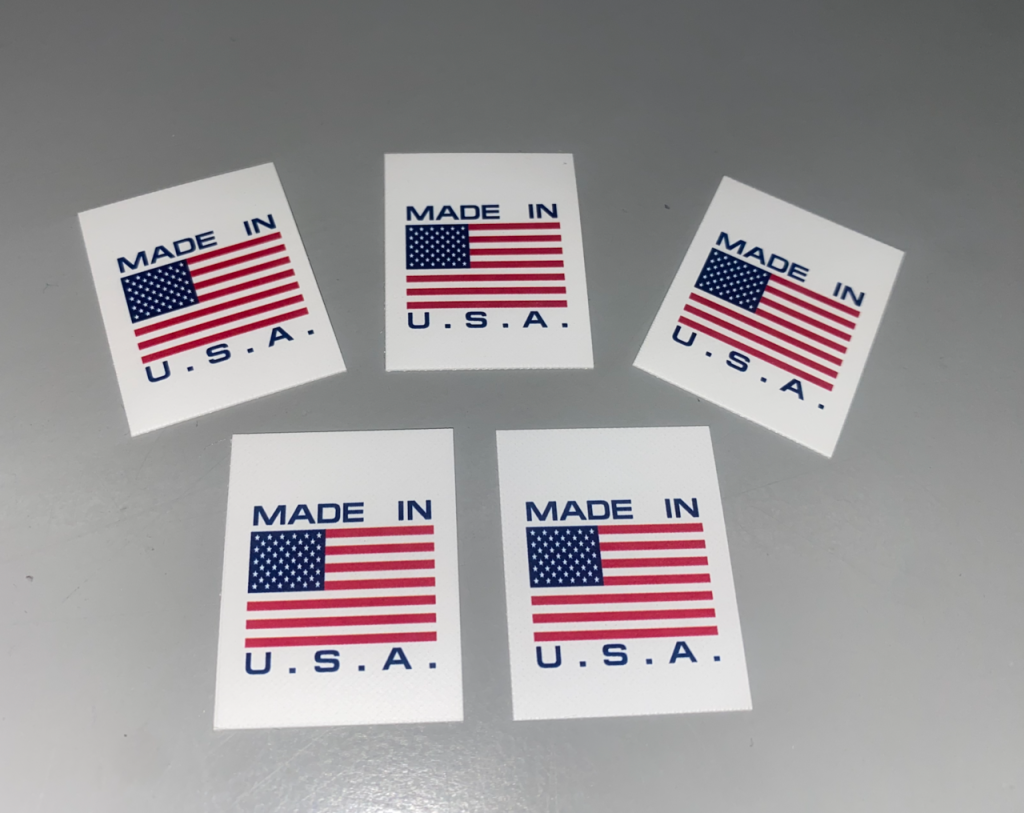
Highlighting True “Made in USA” Products? We Can Help
If your products truly qualify for an unqualified “Made in USA” claim, we make it easy to highlight that clearly and professionally.
We keep sew-in tritext (1.25" x 1") MADE IN USA American flag labels in stock and can order in tyvek labels as well. They’re a simple way to call out domestic origin without redesigning your entire label system — and they’re available with same-day turnaround. Request a quote today and we’ll help you get exactly what you need!
Stay up-to-date with American Law Label
"*" indicates required fields


