
California’s Proposition 65 Warning Labels: They’re Not Just For Furniture
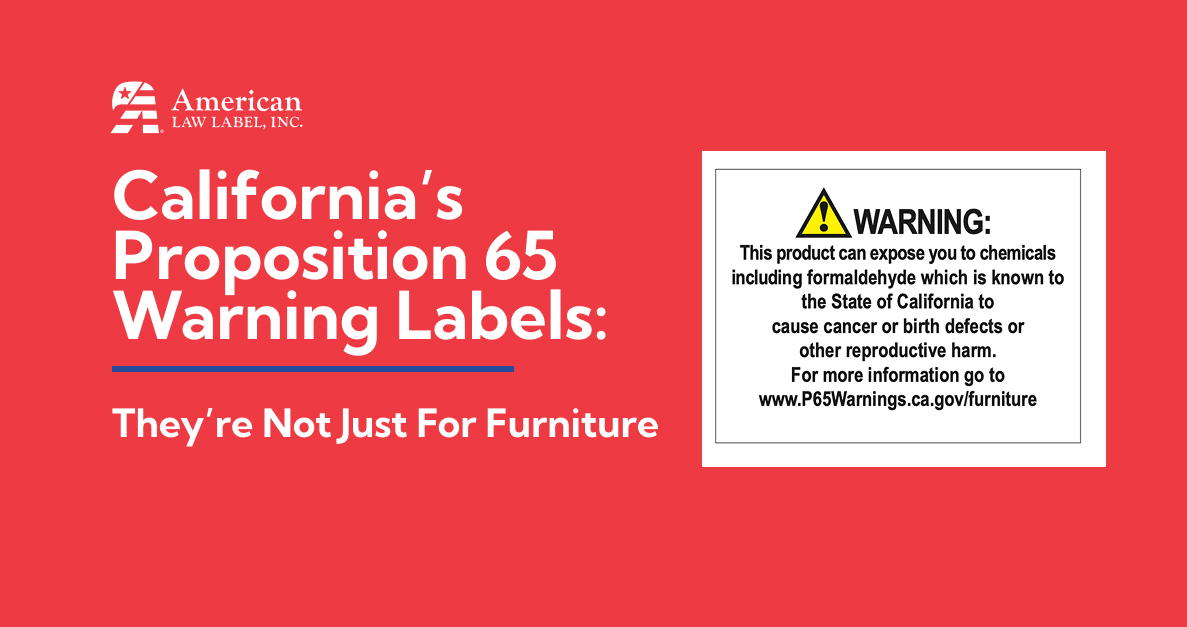
If you’ve ever unboxed something new and seen a big warning label that mentions California and cancer/reproductive harm, you’ve met California’s Proposition 65 in the wild. A lot of people assume it’s only for furniture or bedding because that’s where consumers see it most often.
But Prop 65 warning labels can apply to virtually any consumer product—food, personal care items, electronics, tools, household goods, and more—whenever a product can expose someone to a listed chemical above California’s “safe harbor” levels. And it doesn’t matter where the product is made: manufacturing outside California doesn’t exempt you from Prop 65 if you sell into California.
Let’s break down what Prop 65 is really asking for, what a compliant label needs, and how to avoid expensive mistakes.
What Proposition 65 Requires + Who It Applies To
Proposition 65—formally the Safe Drinking Water and Toxic Enforcement Act—is a California law that requires businesses to provide “clear and reasonable” warnings before exposing people to significant amounts of chemicals that are listed for cancer and/or reproductive harm.
A few key points that trip up even experienced brands:
- It’s exposure-based. The trigger isn’t “your product contains a chemical,” it’s whether typical use can expose consumers above safe harbor levels.
- It’s product-category agnostic. The law isn’t aimed at any one industry; it’s used across categories.
- It’s California-driven, but market-wide. If your company distributes nationally or sells online, rather than trying to geofence compliance; try complying broadly to the market as whole!
If you’re already navigating other labels (law labels, TB-117, TSCA Title VI, tracking labels, etc.), Prop 65 is often one more compliance layer that needs to be integrated cleanly—sometimes literally on the same tag. (This is exactly why “combined label” strategies have become so common.)
Why Prop 65 Shows Up Everywhere
Here’s the simplest way to think about Prop 65: California wants consumers to have a heads-up when a product may add to lifetime risk of cancer or reproductive harm from chemical exposure. Which is valid!
That’s why you’ll see Prop 65 warnings on an enormous range of products—including categories that surprise people:
- Electronics (metals, plasticizers, flame retardants, etc.)
- Personal care (certain ingredients, contaminants, packaging exposures)
- Tools & hardware (dusts, metals, solvents)
- Vehicles, parts, and marine products (operation, handling, servicing exposures)
And yes, furniture is a frequent repeat offender, because certain materials and treatments are common, and exposures can be meaningful enough to trigger warnings.
If you want a quick “zoomed-out” way to sanity check your labeling universe, our guide on what type of label your product needs is a helpful starting point—especially if you’re stacking multiple regulatory requirements.
The Most Common Prop 65 Chemicals We See: Formaldehyde + Wood Dust
In our experience, two chemical callouts come up constantly for furniture and wood-related goods:
Formaldehyde
Formaldehyde is listed under Prop 65 because it can cause cancer, and it can be relevant when products emit formaldehyde gas (often associated with certain resins used in composite wood products).
Wood dust
Wood dust is listed under Prop 65 because it can cause cancer. And exposure can occur during cutting, sanding, manufacturing, or even certain consumer uses/maintenance.
Also worth noting: OEHHA provides sample warning language that includes how to format warnings when chemicals are listed for both cancer and reproductive harm. This “safe harbor” structure is what most brands aim to match so they’re not reinventing the wheel.
Prop 65 label requirements
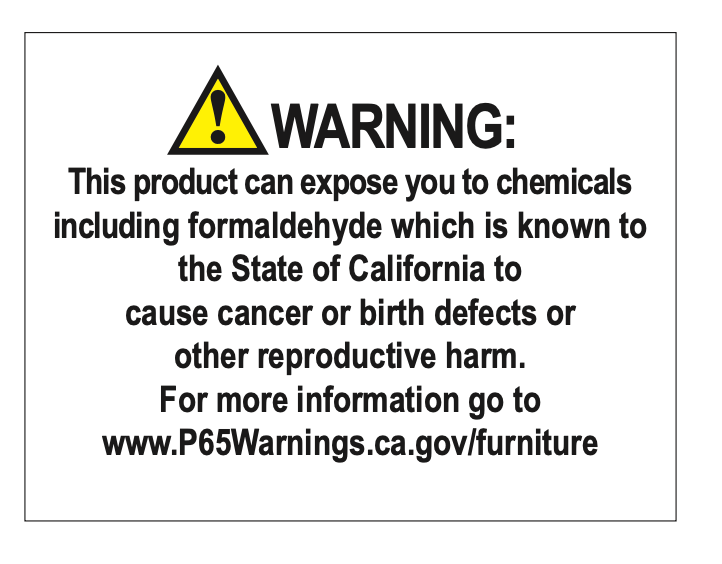
This is where people lose time (and sometimes reprint budgets).
A compliant Prop 65 warning label generally needs:
1) The warning symbol
The symbol is a black exclamation point inside a yellow equilateral triangle with a bold black outline, placed to the left of the warning text. If the product label isn’t printed using yellow, the symbol may be black and white.
2) Standardized signal word + warning language
OEHHA provides standardized “safe harbor” content options (full-length and short-form) depending on product type and chemical listing status.
3) Chemical name(s) (when required)
Many warnings require naming at least one listed chemical. OEHHA’s sample warnings show how chemical names are inserted into the standardized language.
4) A Prop 65 website link
OEHHA’s warnings typically point consumers to the official site for more information.
OEHHA also maintains product/category pages (for example, furniture and passenger vehicles) that businesses commonly reference for product-specific context.
5) Font size + prominence rules
Prop 65 warnings must be conspicuous. The regulations include type-size requirements and minimums (often discussed as “no smaller than the largest type used for other consumer information,” with a 6-point minimum noted in regulatory text and guidance).
If you’re juggling multiple labels on one product (law label + TB-117 + 16 CFR 1633 + Prop 65), it’s easy to accidentally violate one label’s formatting rules while trying to satisfy another. American Law Label’s article on combined product labels is a solid overview of how to consolidate without creating a compliance mess.
Penalties + Practical Next Steps
Prop 65 enforcement is not the place to gamble. California states that penalties for failing to provide required warnings can be as high as $2,500 every violation per day.
A practical, low-drama workflow
- Identify likely exposure drivers (materials, coatings, adhesives, dust-generating use)
- Confirm which warning format applies (consumer product vs. other contexts; full-length vs. short-form options)
- Build label art that matches the symbol/color/font rules
- Document your basis (so you can answer retailer/compliance questions quickly)
- Print labels that hold up (because flimsy labels create their own kind of problem)
Need Prop 65 labels printed? We can help.
American Law Label can provide sewn-in and adhesive (sticker) Proposition 65 labels that meet California requirements:
- Sewn-in labels: turnaround time 2–3 business days
- Sticker labels: turnaround time 5–7 business days
If you want a quote, reach out and tell us:
- product type
- label format needed (sewn-in vs. sticker)
- quantity
- whether you’re combining Prop 65 with other required labels
Stay up-to-date with American Law Label
"*" indicates required fields


