
The Smart Manufacturer’s Guide to Law Label Correction with Adhesive Tyvek Labels
So, you've just discovered that a batch of products went out with an incorrect law label. Maybe the fill content percentages were listed wrong, the manufacturer's address changed, or a material was misidentified. Whatever the error, the products are already assembled and a full relabeling operation sounds expensive, time-consuming, and logistically painful.
Thankfully, there's a better way! An adhesive Tyvek label, applied directly over the misprinted label, can serve as a compliant law label correction … If it's done correctly. Today, we’re walking you through everything manufacturers, importers, and compliance officers need to know about the law label correction process: the material requirements, which state departments require documentation, and how American Law Label can manage the entire process for you.
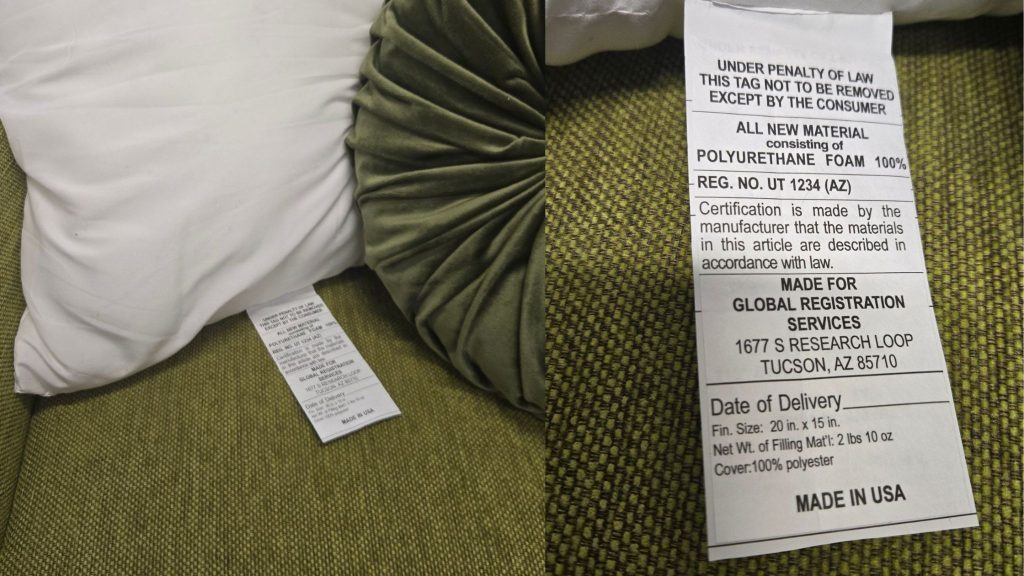
Alt image text: Close-up of a law label attached to a green throw pillow showing fill content, registration number, and manufacturer information for compliance purposes.
Why Law Label Errors Happen
Law labels are regulated by individual states, and the requirements are more detailed than many manufacturers expect. A label might be printed with outdated fill content data, an incorrect registration number, or a manufacturer name that no longer reflects a company restructuring. Even a small inaccuracy can put a product out of compliance.
Pulling products off shelves, removing old labels, and reattaching corrected ones is one option but it's expensive and often impractical when thousands of units are already in distribution. That's where adhesive Tyvek law label correction comes in.
What Makes Adhesive Tyvek A Compliant Correction Material
Now, not just any sticker will do. State regulations are explicit: a corrective label must meet the same material standards as a standard law label. That means it must be durable, non-tearable, and resistant to wear. Regular sticker paper or standard label stock does not meet those requirements and cannot be used for corrective purposes.
Tyvek is a synthetic material made from high-density polyethylene fibers. It's the same durable, tear-resistant material used for primary law labels which is precisely why it's accepted as a correction method. When an adhesive Tyvek label is printed with the correct information and applied over the misprinted label, it creates a durable, readable, and compliant overlay.
American Law Label prints on adhesive Tyvek with a turnaround time of 3 to 5 business days, making this one of the fastest paths to getting products back into compliance.
One important limitation to understand: adhesive labels are approved as a corrective measure, but they are not universally approved as the primary method of label attachment for new products. States will allow an adhesive label as a correction on an existing product, but not all states have issued blanket approval for adhesive-only labels as a permanent labeling solution from the start.
6 Departments That Require Documentation For Label Corrections
While the adhesive Tyvek correction method is widely accepted, six state and city departments require manufacturers to submit documentation before or alongside any corrective labeling.
These departments are: Detroit, Connecticut, Ohio, Oklahoma, Rhode Island, and Utah.
Each of these jurisdictions wants a record of what happened:
- what the original label said
- what the corrected label says
- baseline information about the scope of the correction.
Here's how the documentation requirements break down:
Utah is the most specific. It requires its own variance form that must be completed and submitted to the state.
Detroit, Ohio, Oklahoma, and Rhode Island do not have a specific required form, but documentation must still be submitted. The content and format are more flexible, but the submission is not optional.
Connecticut has an additional requirement: manufacturers must provide information about which retail stores in Connecticut are selling the affected product. This is a detail many companies overlook, and missing it can delay approval.
How American Law Label Handles The Documentation for You
Navigating six different departments — each with their own requirements, contacts, and timelines — is a significant administrative burden. We’ve developed a form that has been pre-approved by the relevant state departments. This form is designed to satisfy the documentation requirements for all six jurisdictions in a single submission workflow.
Here's what the service includes:
- Drafting the documentation
American Law Label prepares the forms on your behalf, capturing the required information: what the original label stated, what the corrected label states, how many products are affected, and the correction timeline. - State submissions
The completed documentation is sent to each applicable department. You don't have to track down contacts or navigate each department's submission process independently. - Label design and printing
In addition to the documentation service, American Law Label can design your corrective Tyvek label and handle printing, all under one roof.
This end-to-end approach means manufacturers can focus on their operations rather than spending weeks corresponding with multiple regulatory offices.
Service Fees
We’re proud to offer transparent, flat-rate pricing for the variance documentation service.
For a single-state variance, the fee is $150 (or $125 for LM/GC subscribers).
For documentation submitted to all six departments, the fee is $450.
Add-on services are available and charged separately:
- Law label design: $175 (or $125 for LM/GC subscribers — and free for subscribers who still have their one complimentary artwork per year available)
- Label printing: quoted based on quantity and specifications
A Note on Who Needs This Service
This service is relevant to any manufacturer, importer, or brand that has discovered a law label error after products have been assembled or distributed. This is why skipping the label proof is so risky! This service could be helpful to furniture manufacturers, bedding producers, stuffed article makers, and anyone else whose products carry a law label under state bedding and upholstered furniture laws.
If you've recently gone through a law label audit and discovered labeling discrepancies, or if a supplier error resulted in incorrect fill content information on your labels, the adhesive Tyvek correction process may be exactly the solution you need!
The Bigger Picture: Variances in the Stuffed Article Industry
The documentation process described above — submitting approval for an adhesive label correction — is one type of variance in the stuffed article and bedding industry. But it's worth noting that it is not the only type.
Variances come in several forms, and each one operates under its own rules and requirements. The Pennsylvania variance, for example, is an entirely different process with its own petition requirements and is still very much in effect. If your products are sold in Pennsylvania, or if you're navigating any other state-specific variance situation, it's important to understand that each variance type must be handled on its own terms.
Ready to Correct Your Labels?
A misprinted law label doesn't have to derail your operations. With adhesive Tyvek correction labels and American Law Label's documentation service, the path to compliance is straightforward and faster than you might expect.
Request a quote or drop us a line to get started. If you have questions about whether your situation qualifies for a corrective label approach, our consulting and training services are also available to walk you through your options.
Stay up-to-date with American Law Label
"*" indicates required fields


